Quick Look
- OC: “Original Character”
- Usage: Fan Fiction, Art Communities
- Origin: Early 2000s Fan Cultures
- Similar: OOC (Out Of Character), OC (Original Content)
- Represents: Creativity, Originality
Acronyms and abbreviations are common, especially on social media and in creative communities. One such abbreviation is “OC,” which stands for “Original Character.” This term is widely used in fanfiction and creative writing circles.
This blog post explains the meaning of OC, exploring its definitions, uses, and examples. It covers the origins of the term and its alternative meanings. Do read through this blog for more information.
What Does OC Mean?
The term “OC” stands for Original Character. It is commonly used in contexts where creative works are discussed, particularly in fanfiction, gaming, and online role-playing communities. An OC is often a character created by a fan or a content creator that exists within the framework of an established universe but is not part of the original narrative. This allows fans to explore their creativity and add depth to the existing storyline or universe.
Creating an OC provides a unique opportunity for fans to engage with the content they love in a personal way. It allows them to express their interpretations or critique of the original work through their characters. These characters can have detailed backstories, distinct personalities, and unique relationships with canonical characters, providing fresh narratives or perspectives within the familiar world.
OCs are particularly significant in fanfiction, where they serve as central figures around which new stories revolve. They are also prevalent in role-playing games (RPGs) and online forums where users create characters to interact with others within a set universe. In these settings, OCs enhance the interactive experience, allowing users to contribute to the community’s dynamic storytelling process.
Where Did OC Come From? The Origin

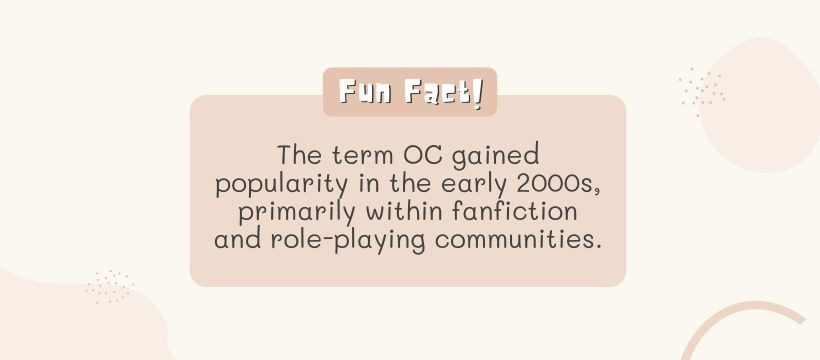
The concept of the Original Character (OC) has its roots deeply embedded in fan culture, particularly within the realms of fanfiction, which began to gain prominence with the rise of online forums and fan sites in the late 1990s and early 2000s. These digital platforms provided a communal space where fans could publish stories that expanded on the universes of their favorite shows, books, or movies.
Originally, the term OC was closely associated with the fanfiction communities that sprouted around popular franchises like “Star Trek,” “Harry Potter,” and “Anime” series. Enthusiasts eager to insert their spin into beloved narratives created characters that could interact with canon characters or even alter the storyline to reflect alternative outcomes or undeveloped plotlines.
As internet usage exploded and more sophisticated platforms for sharing creative work developed, the use of OCs spread beyond fanfiction. They became a staple in other forms of user-generated content, including webcomics, online role-playing games, and various forms of social media where people express their creativity and attachment to a particular fictional universe.
This expansion is tied to the broader democratization of content creation, enabled by accessible publishing tools and vibrant communities supporting and critiquing each other’s work. The evolution of OCs illustrates a shift from passive media consumption to active, creative participation.
Alternate Meanings Of OC
While Original Character is the predominant definition of OC, the abbreviation holds various other meanings across different contexts. Here are some alternative interpretations of OC that are commonly encountered:
- Obsessive Compulsive: In medical and psychological discussions, OC often refers to obsessive-compulsive behavior, highlighting patterns of behavior characterized by excessive thoughts (obsessions) that lead to repetitive behaviors (compulsions).
- Officer In Command: In military and law enforcement jargon, OC can denote an Officer in Command, referring to the person responsible for leading and managing a unit or department.
- Orange County: Geographically, OC is widely recognized as an abbreviation for Orange County, located in California, USA. It’s known for its significant cultural influence, surf culture, and affluent communities.
- Open Circuit: In electrical engineering, OC represents an open circuit, indicating a break in a circuit that stops the flow of current.
- Operational Capability: In business and technology contexts, OC refers to Operational Capability, describing an organization’s or system’s capacity to perform a given function effectively.
These alternate meanings demonstrate the broad applicability of the abbreviation OC, showing its integration into various professional, regional, and technical vocabularies. Each usage reflects specific community or field conventions, underscoring the importance of context when interpreting abbreviations.
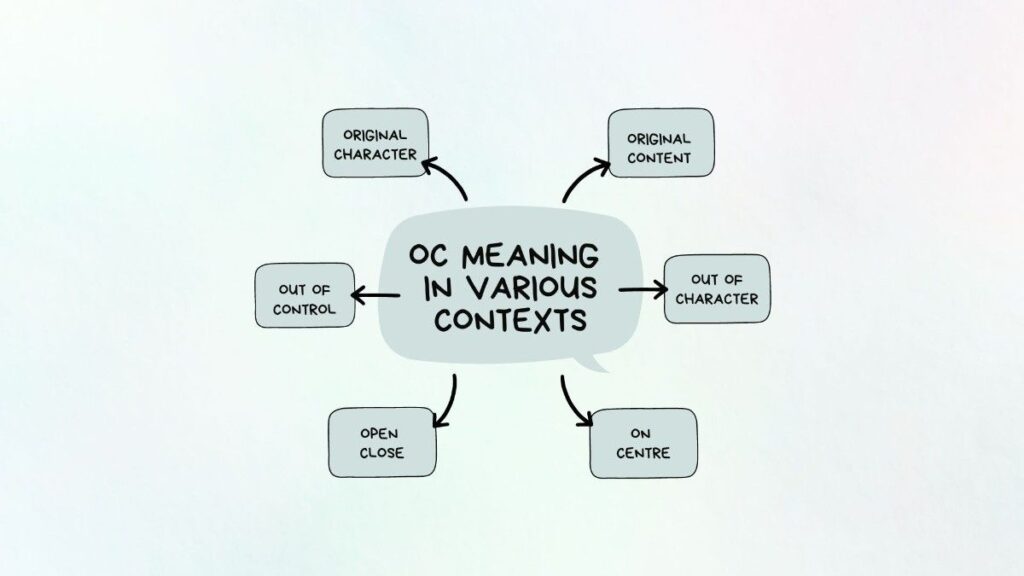
Other Related OC Acronyms
The abbreviation “OC” not only stands for Original Character but also shares its initials with other significant acronyms that vary widely in meaning across different fields and industries. Below are some notable OC-related acronyms:
- OCP – Obsessive Compulsive Personality: This is related to OC in the psychological context, describing a personality style characterized by a preoccupation with orderliness, perfectionism, and control.
- OCI – Overseas Citizenship Of India: Relevant in legal and immigration contexts, OCI refers to individuals of Indian origin who have citizenship in another country but are still connected to India through their ancestry.
- OCS – Officer Candidate School: In the military, OCS is a program where graduates are commissioned as officers in the armed forces, showing a parallel to OC’s meaning of Officer in Command.
- OCD – Obsessive-Compulsive Disorder: This is a more specific medical term related to OC, describing a mental health condition where a person has uncontrollable, recurring thoughts (obsessions) and behaviors (compulsions) they feel the urge to repeat over and over.
- OCG – Organized Crime Group: In law enforcement and criminal justice, OCG is an acronym for Organized Crime Group, indicating a structured group engaged in criminal activities.
Who Uses OC And Where?
The use of OC (Original Character) spans across various creative and digital platforms, illustrating the widespread appeal and utility of original characters in narrative development. Here’s a breakdown of who uses OCs and where they are most commonly found:
- Fanfiction Communities: OCs are a staple in fanfiction, where fans of books, movies, TV shows, and other media create new characters to integrate into established universes. This allows fans to explore “what if” scenarios, develop side stories, or focus on personal themes that the original work might not cover.
- Role-Playing Games (RPGs): Both in video games and tabletop RPGs, players often create their own characters, designing their backstories, abilities, and motivations. OCs enable players to fully immerse themselves in the game’s world, making the experience more personal and engaging.
- Online Forums And Social Media: Platforms like Tumblr, Reddit, and DeviantArt are popular for sharing and discussing OCs. Creators use these spaces to showcase their art and stories, receive feedback, and interact with a community that appreciates original creative work.
- Art And Design: Many artists create OCs to express their artistic skills and storytelling abilities, often building portfolios around these characters. These OCs can be used in comics, illustrations, and animations.
- Educational Contexts: In some educational settings, teachers and students use OCs to explore literature, history, and social studies by creating characters that could exist within certain periods or settings, enhancing learning through creative engagement.
How To Use OC? (With Examples)
Using an Original Character (OC) effectively in various contexts can enhance storytelling, provide deeper engagement, and allow for creative expression. Here’s how to use an OC, accompanied by examples and dialogues to illustrate practical applications:
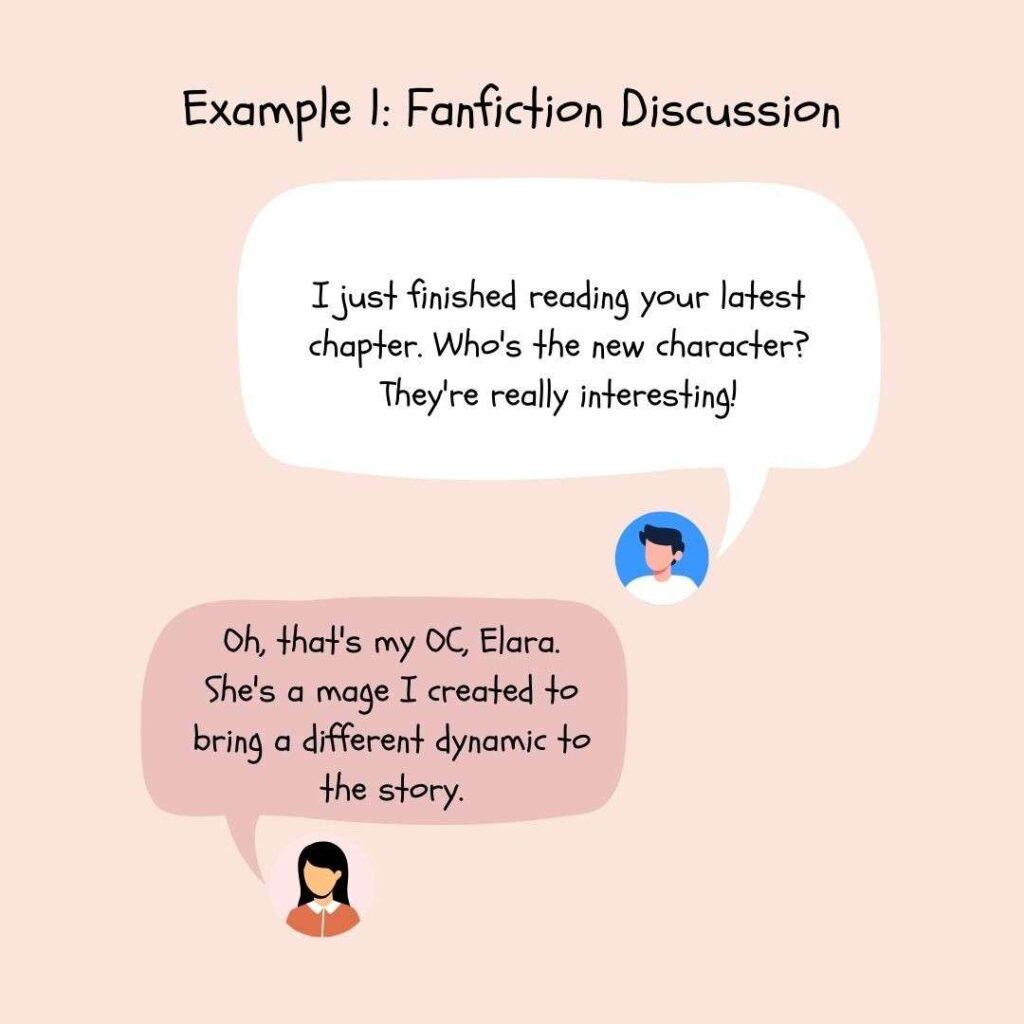
Example 1: Fanfiction
Context: Adding an OC to a popular fantasy series. OC Name: Elara, a young mage discovering her powers. Dialogue:
- Elara: “I never asked for these powers, but I can’t ignore them anymore.”
- Canon Character: “We all have our destinies, Elara. Yours might just change the world.”
Example 2: Role-Playing Game (RPG)
Context: Introducing an OC in a tabletop RPG. OC Name: Thorne, a rogue with a mysterious past. Dialogue:
- Thorne: “Trust is earned, not given freely in the alleys of Darkwood.”
- Party Member: “Then earn ours, as we earn yours, Thorne.”
Example 3: Online Forum Role-Playing
Context: Using an OC in an online storytelling forum. OC Name: Aria, a space explorer in a sci-fi universe. Dialogue:
- Aria: “These stars hold secrets meant for us to find.”
- Forum Member’s OC: “And we’ll uncover them, one galaxy at a time.”

Example 4: Creative Writing Class
Context: Developing an OC for a class project. OC Name: Marcus, a detective in the 1920s. Dialogue:
- Marcus: “Every clue tells a story, you just need to listen.”
- Classmate’s OC: “Then let’s make the city speak, detective.”
Example 5: Comic Book
Context: Creating an OC for an original comic series. OC Name: Lyra, a superhero with the ability to manipulate light. Dialogue:
- Lyra: “Shadows flee where light prevails, and I bring the dawn.”
- Villain: “Then let’s see if your light can outshine my darkness.”
How To Reply To OC (With Examples)
Responding to an Original Character (OC) in various narrative or interactive settings can enhance dialogue and further develop the character’s role in the story. Here are a few examples that might help.
Example 1: Fanfiction Interaction
OC Name: Elara, the young mage. Dialogue:
- Elara: “The magic within me scares me more than the enemy does.”
- Canon Character: “But it’s that very power that could save us all, Elara. Let me help you control it, not fear it.”
Example 2: Role-Playing Game (RPG)
OC Name: Thorne, the rogue. Dialogue:
- Thorne: “I might have a lead on the artifact, but it’s guarded heavily.”
- Party Leader: “Then we plan carefully. Your skills are crucial, Thorne. Guide us there.”
Example 3: Online Forum Role-Playing
OC Name: Aria, the space explorer. Dialogue:
- Aria: “I propose we take the route through the Nebula Cluster. It’s risky, but fast.”
- Forum Member’s OC: “Agreed, Aria. Your bold strategies have never led us astray before.”
Example 4: Creative Writing Class
OC Name: Marcus, the 1920s detective. Dialogue:
- Marcus: “The pattern is clear if you look closely at the victims’ histories.”
- Classmate’s OC: “You’re right, Marcus. Your insights could finally crack this case wide open.”
Example 5: Comic Book
OC Name: Lyra, the superhero. Dialogue:
- Lyra: “This city is under my protection now. Darkness will have no place here.”
- Sidekick OC: “And I’ll stand by you. Your vision of light is what we’ve needed, Lyra.”
Facts About OC
- Origin: The term Original Character (OC) originated from fan communities in the late 1990s.
- Fanfiction Staple: OCs are a core element in fanfiction, allowing fans to create new narratives within established universes.
- Creative Expression: OCs offer a platform for personal creativity, enabling creators to explore themes not covered in the original work.
- Widespread Use: OCs are prevalent in fanfiction, role-playing games, webcomics, and online forums.
- Community Interaction: OCs often serve as a point of interaction and collaboration within creative communities.
- Ownership: Creators have full control over their OCs, making them an essential aspect of user-generated content.
- Diverse Applications: OCs are used across various genres, including fantasy, sci-fi, romance, and historical fiction.
- Character Development: Developing an OC involves creating a backstory, personality traits, and unique abilities.
- Fan Art: Many artists create and share fan art based on OCs, further enriching the character’s presence online.
- Educational Use: OCs are sometimes used in educational settings to help students engage with literature or historical contexts.
Other Common Abbreviations Parents Should Know
Understanding internet slang can help parents stay informed about the way their children communicate online. Here are 15 common abbreviations and their meanings:
- GTS: Stands for “Go To Sleep,” often used in conversations to indicate it’s time to rest.
- YW: Short for “You’re Welcome,” typically used in response to someone saying thank you.
- BTW: Means “By The Way,” used to introduce a new topic or additional information.
- OG: Refers to “Original Gangster,” but it’s often used to describe someone who is authentic or an originator in a particular area.
- KMS: Stands for “Kill Myself,” a potentially serious term that parents should be aware of, often used in a hyperbolic way, but it can be concerning.
- AFK: Short for “Away From Keyboard,” indicating that someone is temporarily not available online.
- BRB: Means “Be Right Back,” used when someone steps away from a conversation briefly.
- IDK: Stands for “I Don’t Know,” a common response in text and online chats.
- IMO: Short for “In My Opinion,” used to express a personal viewpoint.
- IRL: Stands for “In Real Life,” distinguishing between online and offline experiences.
- SMH: Short for “Shaking My Head,” used to express disbelief or disappointment.
- TBH: Means “To Be Honest,” often used to introduce a frank opinion.
- NVM: Stands for “Nevermind,” used when a previous statement is retracted or deemed unnecessary.
- FWIW: Means “For What It’s Worth,” used to offer a perspective that may or may not be valuable.
- TL;DR: Stands for “Too Long; Didn’t Read,” often used to summarize lengthy texts or indicate that something is too lengthy to engage with fully.
FAQs:
It’s best to ask for permission before using someone else’s OC, as these characters are often personally crafted and owned by their creators.
A good OC has a well-developed backstory, distinct personality traits, and meaningful connections within the story’s universe.
No, OCs are also used in role-playing games, webcomics, and online forums.
Start by outlining the character’s backstory, personality, and role in the story or game. You can also sketch or visualize their appearance.
Yes, OCs can be related to canon characters, but it should be done thoughtfully to maintain the integrity of the original story.
No, OCs can be any species or entity depending on the creative universe they’re part of, including animals, aliens, or fantastical creatures.
An OC is a completely original creation, while a self-insert is a character based on the creator themselves.
While OCs are typically associated with fan works, they can be adapted into professional projects if they are original and not derivative of copyrighted material.
Constructive criticism is generally acceptable, but it’s important to be respectful and considerate of the creator’s effort and creativity.
Conclusion
We hope you found this guide on OC informative and helpful. If you’re curious about more internet slang terms and their meanings, feel free to explore our site for additional resources. Stay informed and keep learning!